


Compulsive hoarding, or hoarding disorder as you prefer is a mental state where a person finds it difficult to get rid of possessions. The outcome is these items pile up in their home, regardless of whether they are of real, little or no value. This article explores the condition in more detail, before unpacking the five stages of hoarding.
The Stages of Hoarding in Context
This condition, if left unchallenged which is difficult, may have the following consequences:
- Many aspects of the hoarder’s life suffer, including personal, family, social, educational, and occupational aspects.
- The person with the affliction has repeated urges to accumulate more, and add to their growing pile of possessions.
- Attempts by well-meaning significant others to clear away and tidy up, encounter stiff resistance to discarding any of them.
- The home is increasingly cluttered to the point where their health and safety in under threat. Someone must do something!
How Common Is Compulsive Hoarding Worldwide?
Hoarding is sufficiently prevalent to appear as a separate condition in both current revisions of International Classification of Diseases, and Diagnostic and Statistical Manual of Mental Disorders. Medical statisticians estimate it affects between 2% and 5% of all adults.
A mild condition may first begin in childhood. However the five stages accelerate with aging, and may become severe among those who live alone, and are largely untended. Coexisting conditions commonly include:
- Anxiety, obsessive compulsive disorder, attention deficit hyperactivity disorder, and / or depression.
- Alcohol dependence and paranoid, schizotypal and avoidance traits, driving family and friends away.
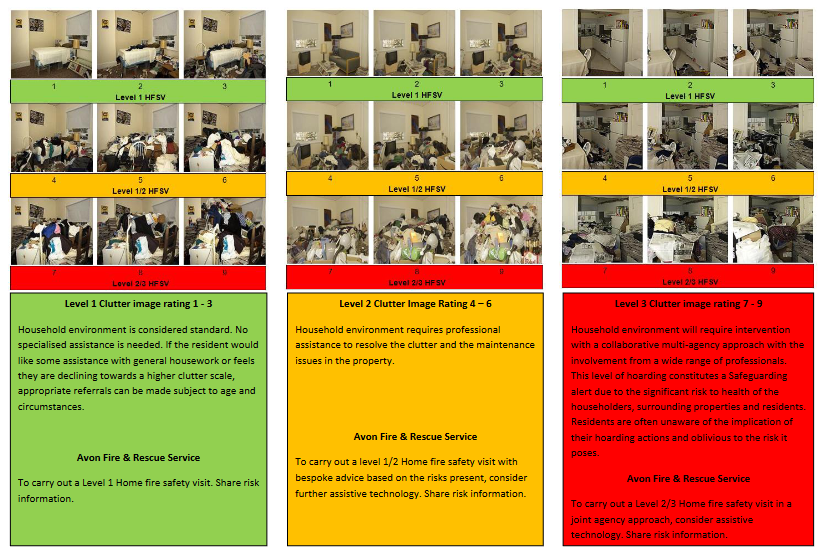
There are various ways to assess the severity of the hoarder’s safety situation. For example, here is a visual prompt emergency services find handy when conducting their safety inspections.
The Five Stages of Compulsive Hoarding
Hoarding may begin as a mild distraction in childhood, but become severe in old age. It can also erupt at any stage in our life cycle, after we face emotionally destructive moments.
The best we can do is watch out for the warning signs in ourselves and others. And then seek advice from a competent specialist. The steps we describe below are progressive and cumulative as the one builds upon the other. We derived them from a report by National Study on Compulsive Disorganization. Note that progression to the next stage is not inevitable.
Stage One of Hoarding
The early signs are already there. Collection has begun on a small scale, although the items are disorganised with little sign of pride. Moreover, these usually lurk in over-stuffed cabinets, or behind locked doors of garages or sheds. Hence, the compulsive hoarder is not always obvious during the early stages of hoarding.
Although we may notice they always seem to be out shopping, and find throwing anything away challenging and difficult. Beyond this, the household is neat and tidy. There are no untoward smells lingering. The hoarder is coping well.
Hoarding Phase Two
Hoarders become aware of their situation as their clutter spreads. They start finding ways to avoid other people visiting their home. Exposing their growing accumulation to others seems to cause them anxiety, stress, even embarrassment. The National Study on Compulsive Disorganization suggests they will benefit from professional support.
The outward signs include blocked exits from the house, broken-down appliances, and failed HVAC systems. Regular housekeeping routines fade away. Mildew and stale odors begin to appear. Intervention is steadily becoming unavoidable!
Stage Three of Hoarding
The National Study on Compulsive Disorganization proposes some degree of intervention at this point, before the situation deteriorates further. However, it recommends a lead by a professional organizer assisted by other resources, including mental health support.
The outward signs of the middle stages of hoarding may include among others:
- A very poor level of personal hygiene, coupled with emotional distress.
- Loss of control over weight, overt defensiveness of their personal situation.
- Further aggravation of neglect throughout the home or space they occupy.
- Some signs of light structural damage, one bedroom cluttered beyond use.
- Badly soiled floors, excessive pets, visible rodent, flea, and / or spider invasion.
Hoarding Level Four
Level four represents a stage where intervention is no longer a ‘nice to have’ if it ever was. Seasoned professionals describe this as a state in which the sewage system is no longer working as it should, and a stink of rotten food permeates the home. Where there are pets, their waste seems everywhere. The hoarder’s collection has taken over several rooms.
Possible strategies include a seasoned facilitator overseeing pest control services, and other providers to recover living spaces. This is the point where Avery Associates home-clearing services may become indispensable. We have been doing this for many years. We have professional valuators able to identify and recover valuable items worth keeping.
Stage Five of Hoarding
This phase represents the point of no return for the victim of the condition. They have hung in there during the first four stages of hoarding, but now they have run out of road. The place they called home has become uninhabitable. It is time to move the person out temporarily or permanently. Call Avery Associates to pick up the pieces, and make a fresh start.

