


Most property transactions in England and Wales appear in the UK Land Registry, although registration is not mandatory. Executors may have to look elsewhere, especially in the case of older transactions. Following the chain of property ownership in estates may lead to the National Archives, containing records going back to the year 1227.
Incomplete Record of Property Ownership
HM Land Registry has become the primary source of property data in England and Wales, since it established in 1862. However, using this service only became compulsory in 1990. Some 10% of freehold land does not appear in the Registry, including property which has not changed hands for a long time.
An executor of a deceased estate with a legal will, should already know the deceased’s intentions. However, where there is no legal will, then the administrator has to rely on the UK laws of succession. National Archives records are also incomplete, although they may help fill in the pieces.
The National Archives contain records of titles to land that enrolled at the central law courts. Typically, this may have been because there was a dispute at the time. However, purchasers of property sometimes created fictitious disputes, as an inexpensive way to list their rights in court records.

How National Archives List Property Ownership
There is no general standard for recording the chain of property ownership in estates, in The National Archives. However, the records there may contain some, all or more of the following information:
- Personal information about the buyer and the seller.
- Description of the subject land and its location.
- Details of what the purchase included and excluded.
- Other conditions underlying the property transaction.
- Information about earlier owners of the land.
If you encounter a record in Latin or another unfamiliar language, then there are free online translation services available. The National Archives evolved through several iterations over time, of which the following is the latest:

- Most enrollments of private deeds from the 13th century to 1535, are available by following this link.
- From 1536, transfers of land by bargain and sale were enrolled in law courts by local clerks of the peace.
- Registration of deeds on close rolls became less frequent, after the Land Registry established in 1862.
- Some enrollment of private deeds continued, until supreme court enrollment books replaced the old system.
The Chain of Property Ownership in The Archives
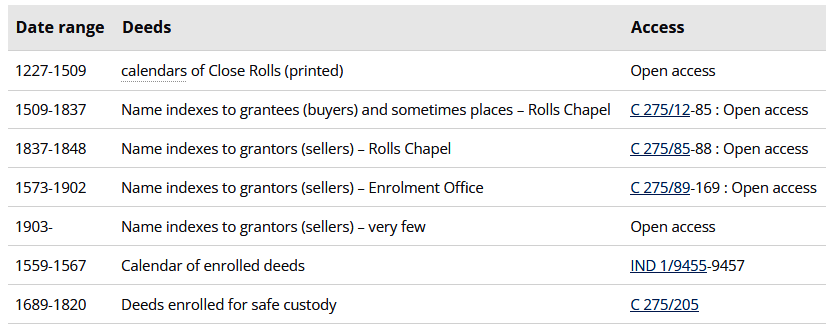
There a several ways of tracing the chain of property ownership in estates in The National Archive, as per the table below. The data is in the close rolls of C 54. These are indexed by the initial letter of one party generally, requiring scrolling several pages to zoom in on the information.
Other Court of Law Records that May Assist
If the C 54 records draw a blank, then there is a chance of tracing information in other court of law records. The National Archive confirms that there is no overall index to assist such a search. Instead, they offer the following catalogue that may assist:
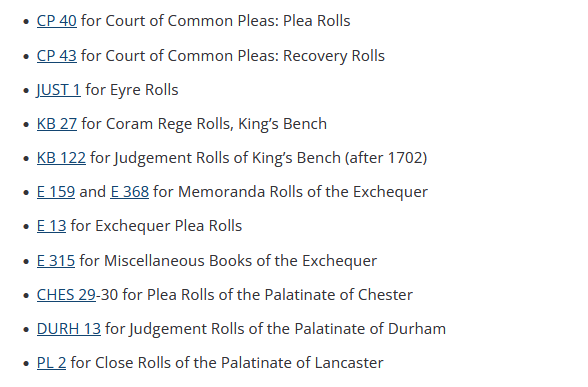
Click on the link below the table and scroll down to Section 5 for live links.
Property Ownership Records by Final Concord
Final concords were land transfers via legal action. They resulted in final agreements between purchasers and sellers. They were, however, often filed in the public records of the sovereign’s court, as fictitious legal disputes.
It was customary to write the final concord three times on a single piece of parchment, with the court retaining the bottom one as a central record of transfer. These records are available at National Archives CP 25/1 and CP 25/2.
Private Conveyances by Common Recovery
Private conveyances were another way to record property transactions in the guise of disputes, in the absence of a central register. The practice arose in the 15th century, as a way to break up family trusts that prevented heirs selling:
- Access records before the Easter term in 1563, by visiting the plea rolls of the court of common pleas in CP 40.
- From 1583-1835, the conveyances were enrolled on a separate series of recovery rolls in CP 43.
- Alternatively, use contemporary finding aids referred to in the catalogue description of CP 43.
- The latter may include the names of the parties in the case, the county, and the relevant membrane number within the roll.
Valuing a Subject Property for Inheritance Tax
Once you have traced a property in a deceased estate that is not on HM land Registry, your next step is to value it for inheritance tax. Look no further than a RICS valuer on the Avery register. We’ll provide all the paperwork to ensure a smooth passage through the tax assessment.
More Information
Residential Property Valuations By RICS Surveyors
Selling Property From a Deceased Estate
I cannot thank Mr Avery enough, the valuation was prompt, accurate and excepted easily by HMRC I would thoroughly recommend this company if you are in need of inheritance tax valuations of house contents. Jamie


